
01
Candidate site ranking
Score each site by target-customer reach, visit potential and competitor overlap, not just population density.
Use case / Retail Site Selection
Compare candidate stores by the customers they can reach, the demand around them and the competition they will face. Spotzi combines mobility, household and points-of-interest data so retail teams can rank sites before committing to a lease.
Catchment demand / competitor overlap / target-customer reach
What the analysis improves
A good retail location is more than a busy street. Spotzi scores each candidate against the customers you want and the network you already operate.
From signal to store visit
Score each site by target-customer reach, visit potential and competitor overlap, not just population density.
See how far customers realistically travel and how much demand falls inside five, ten or fifteen-minute catchments.
Map competing stores, complementary brands and destination points of interest that shape visit behaviour.
Estimate how a new store could pull visits from existing locations before you add it to the network.
Start with a market, a set of addresses or a competitor set. Spotzi scores each candidate against the audience you want, the demand around it and the stores already serving that demand. Your team gets a clear shortlist with the evidence to defend it.
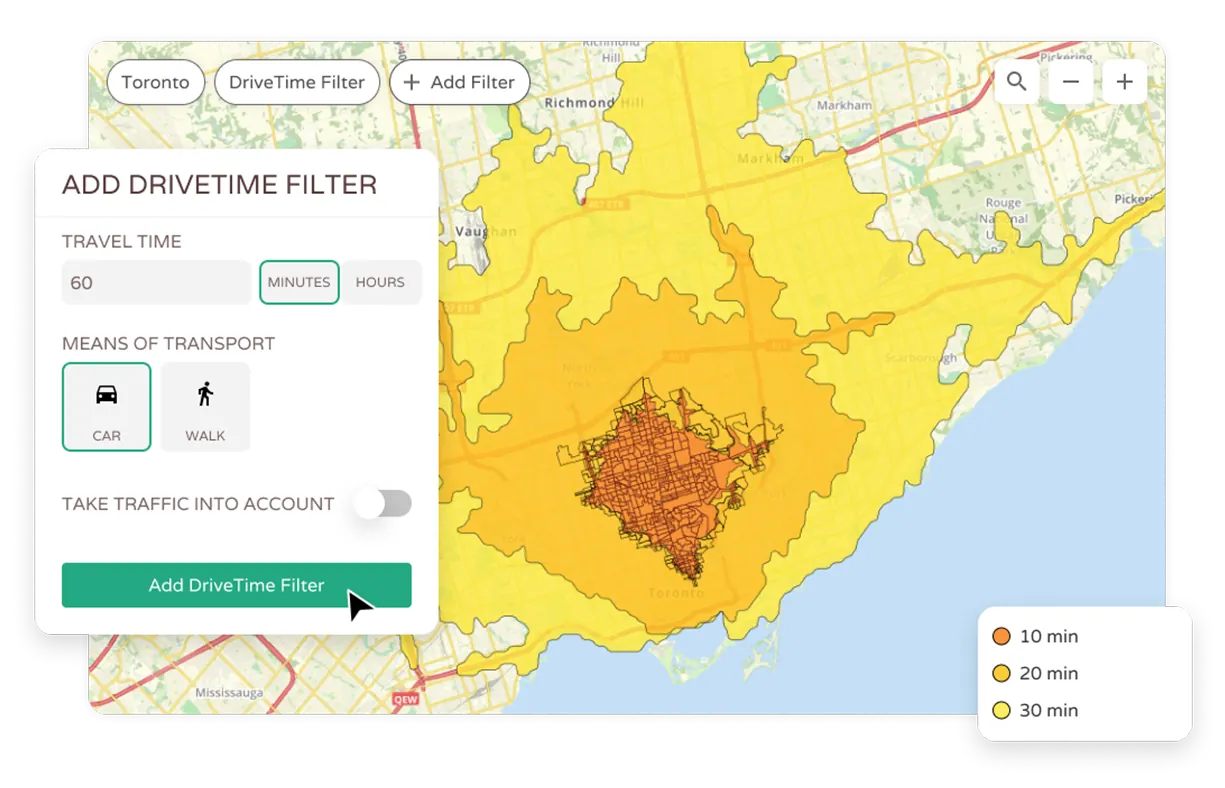
Compare sites by the share of your target audience inside the catchment, not by total footfall alone.
See how many households, workers and visitors fall within realistic travel times and how that demand changes by daypart.
Map competing stores, complementary destinations and the places customers visit before and after a potential store.
Compare catchments across the network to estimate overlap and cannibalisation risk before a lease decision.
Bring the evidence together in a ranked shortlist your property, strategy and finance teams can review together.
A market, candidate addresses or a trade area is enough to start. We combine mobility, household, points-of-interest and competitor data around each location.
Yes. The same method can be applied across cities and countries, provided the required data coverage is available in each market.
A typical output includes a ranked site shortlist, catchment maps, target-audience reach, competitor context and cannibalisation indicators.
No. Existing customer data can make the analysis more specific, but it is not required to evaluate a market or a candidate site.
Yes. Including the current network makes it possible to assess overlap, gaps and the incremental value of a new location.
The decision layer for real-world marketing
Send us a market, a shortlist or a competitor set. We will show you how a site selection analysis would rank the options.
Spotzi in numbers
700M+
people in motion daily
5,000+
audiences
Millions
points of interest